Exhibit 1.1Table
Digital Companion
Exhibits
Every exhibit in the book, as a vector file where the exhibit is a figure and as an Excel workbook where it is a table, ready to place in your own presentations and documents.
How you may use these exhibits
Free to use and adapt in your own work, provided the attribution stays with the exhibit. Downloading a file is your agreement to these terms.
The exhibits on this page are from CTRM for Bulk Liquids: A Practitioner's Guide to Strategy, Selection, Implementation, and Operation by Kent B. Landrum (Thin Leaf Press, 2026). They are provided for readers of the book and for practitioners working on CTRM strategy, selection, implementation, and operation.
You may use them in internal presentations, working documents, and training material within your own organization, and in proposals and client work where the source is shown. Keep the attribution line that appears in each file, or cite the book and this site where you use the exhibit. You may edit a file to suit your purpose, for example to add your own figures to a table, provided the attribution remains and the result is not presented as the published original.
The exhibits are offered as they appear in the first edition. Where an update on this site changes one, the Errata & Updates page says so. Downloading a file is your agreement to these terms and to the site's terms of use.
56 of 56 exhibits
Chapter 1CTRM in Context: Who Uses It, for What, and Where
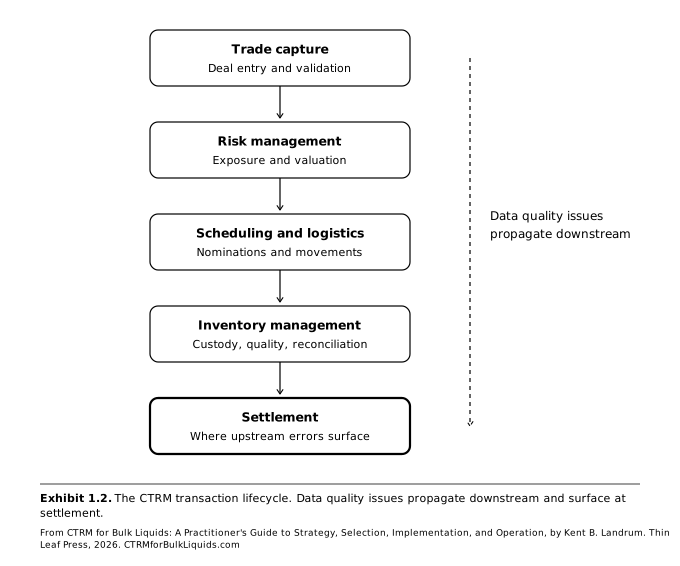
Exhibit 1.2Figure
The CTRM transaction lifecycle.
Data quality issues propagate downstream and surface at settlement.
Chapter 2Strategy First: Commercial Objectives
Exhibit 2.1Figure
The four levels of trading sophistication.
Reporting cadence, controls, staffing, and system investment rise with each level.
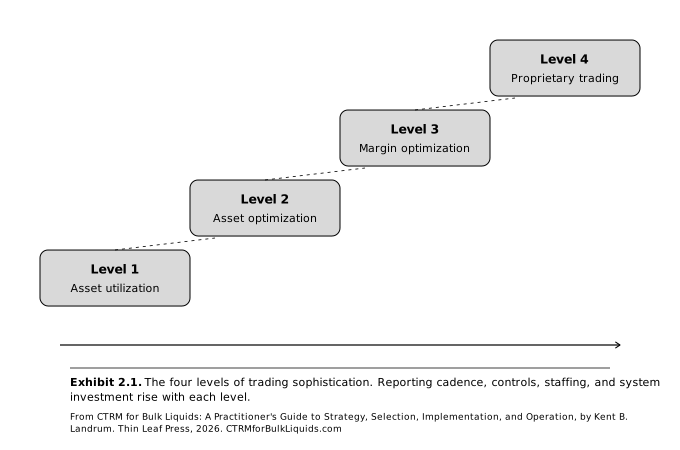
Exhibit 2.2Table
Chapter 3Risk Appetite and Regulatory Exposure
Exhibit 3.1Table
Chapter 4Assessing Business Capabilities and Organizational Readiness
Exhibit 4.1Table
The five pillars of commercial readiness and their CTRM design implications.
Further readingWhat you Need to Know Before Starting an ETRM System Implementation Process (Article, Energies Media, 2019)
Exhibit 4.2Figure
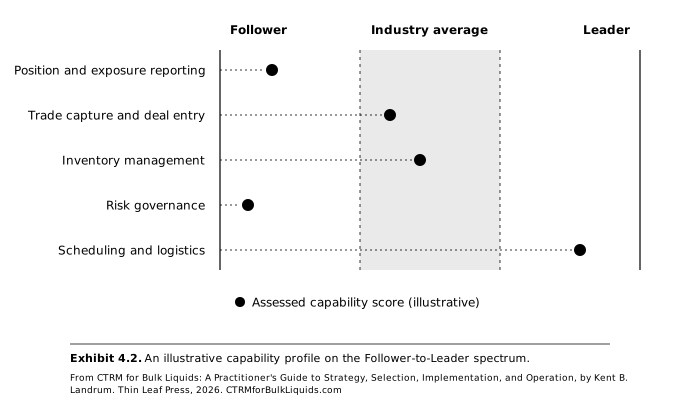
Exhibit 4.3Table
Chapter 5Evaluating IT Strategy and Execution Capabilities
Exhibit 5.1Table
Chapter 6Understanding the Vendor Landscape
Exhibit 6.1Table
Exhibit 6.2Table
Vendor landscape orientation by buyer profile and primary fit.
Further readingCTRM & RM Sourcebook of Software Suppliers and Products (Report, Commodity Technology Advisory, 2025; free with registration) ETRM & CTRM Software Selection in the Digital Era (Article, Energies Media, 2021)
Chapter 7Requirements Definition for Bulk Liquids and Renewables
Exhibit 7.1Table
Exhibit 7.2Table
Exhibit 7.3Table
Chapter 8Integration with External Systems
Exhibit 8.1Figure
The three ERP integration boundary options on the transaction lifecycle.
Everything left of the chosen boundary runs in the CTRM; everything right of it runs in the ERP.
Further readingLeading Practices for Integrating ETRM & ERP Systems (Article, LinkedIn, 2017)
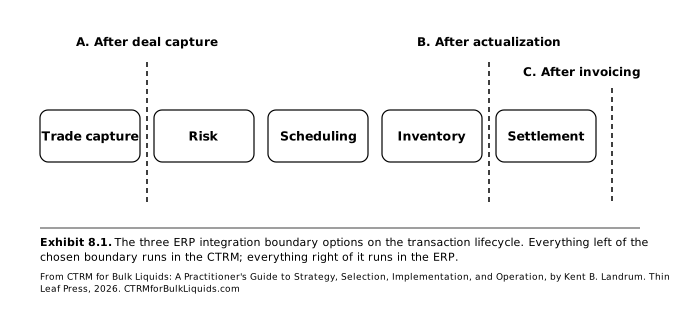
Exhibit 8.2Table
The CTRM integration landscape.
Further readingPreparing for Digital Downstream Supply Chain Capabilities (Article, Hydrocarbon Processing, 2018; via Opportune Insights)
Exhibit 8.3Table
ERP integration scenario comparison.
Further readingIntegrating ETRM and ERP Systems (Presentation, Best Practices for Oil & Gas, 2013; with Yael Urman)
Exhibit 8.4Table
Chapter 9Cybersecurity and Risk in System Architecture
Exhibit 9.1Table
Exhibit 9.2Figure
RTO and RPO on a failure timeline.
RPO looks backward from the failure to the last verified backup; RTO looks forward from the failure to restored operations.
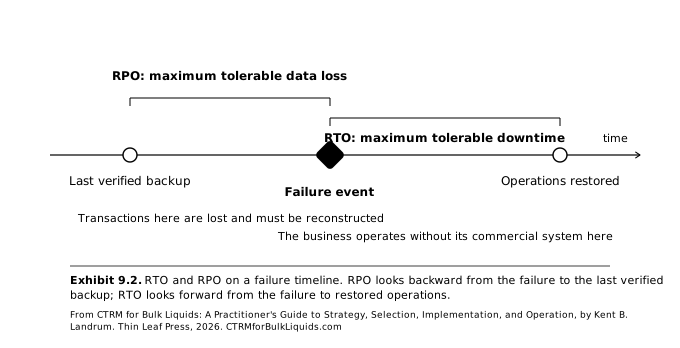
Exhibit 9.3Table
Exhibit 9.4Table
Legacy CTRM security posture assessment framework.
Further readingThe Cybersecurity Risk Posed By Your Outdated ETRM System (Article, JD Supra, 2021)
Exhibit 9.5Table
Chapter 10RFP and Evaluation Framework
Exhibit 10.1Table
Exhibit 10.2Table
Exhibit 10.3Table
Exhibit 10.4Table
Exhibit 10.5Figure
Cumulative cost of ownership for two deployment models, illustrative.
A year-one comparison and a year-five comparison select different platforms.
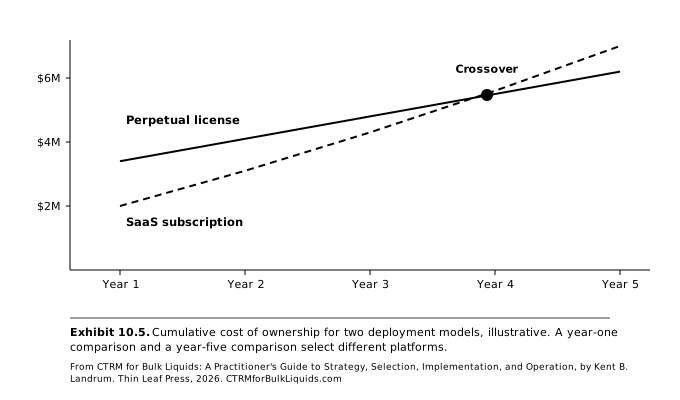
Exhibit 10.6Table
Chapter 11Project Governance and Delivery Models
Exhibit 11.1Table
Exhibit 11.2Table
Accountability lane model for SI and vendor.
Assignments are representative; specific programs will vary based on the vendor's professional services scope and the SI engagement model.
Further readingTrading on Trust: Making SI–Vendor Partnerships Work in ETRM Implementations (Article, LinkedIn, 2025)
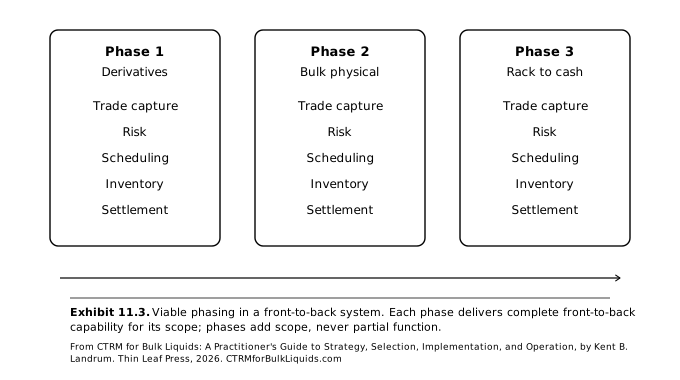
Exhibit 11.3Figure
Viable phasing in a front-to-back system.
Each phase delivers complete front-to-back capability for its scope; phases add scope, never partial function.
Chapter 12Configuration vs Customization
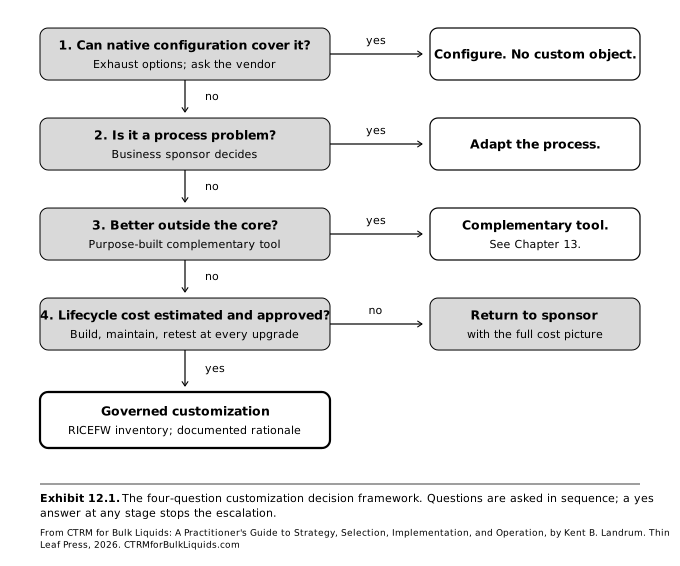
Exhibit 12.1Figure
The four-question customization decision framework.
Questions are asked in sequence; a yes answer at any stage stops the escalation.
Further readingThe (Technical) Debt Harvest in an ETRM Upgrade (Article, LinkedIn, 2026)
Chapter 13Bridging the Gaps: When Core CTRM Isn’t Enough
Exhibit 13.1Table
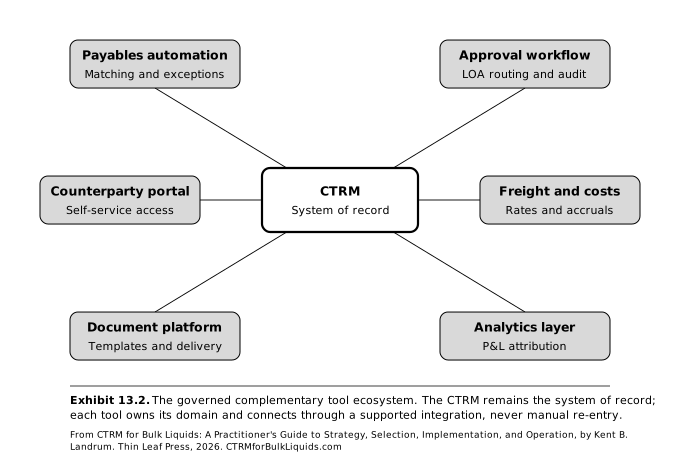
Exhibit 13.2Figure
The governed complementary tool ecosystem.
The CTRM remains the system of record; each tool owns its domain and connects through a supported integration, never manual re-entry.
Further readingFrom Monolith to Marketplace: Why Enterprise Energy Software Solutions Need an App Store Ecosystem (Article, LinkedIn, 2025) 10 Ways To Build Layers Of New Value Around Your ETRM System (Article, JD Supra, 2022)
Chapter 14Data Management, Testing, and Cutover
Exhibit 14.1Figure
The four transaction cutover rules at the go-live boundary.
Bars show where each transaction category executes; the amber points mark where an opening balance carries value across the line.
Further readingLeading Practices for ETRM System Conversion, Cutover & Go-Live (Article, Energies Media, 2021; with Jason Wilton)
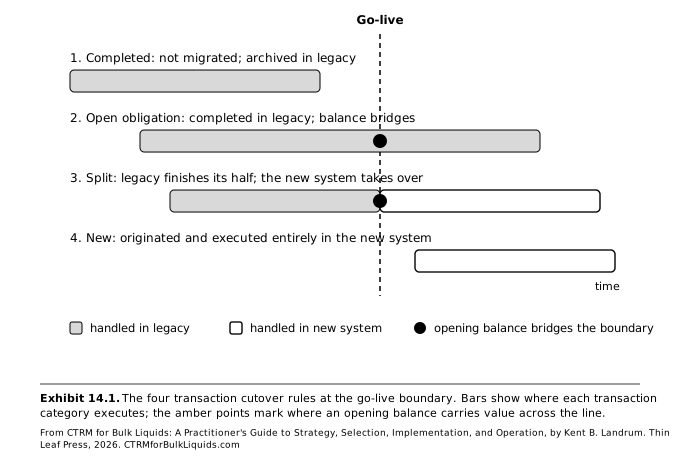
Exhibit 14.2Table
Transaction cutover decision framework.
Every in-flight transaction category must be assigned an explicit handling rule before the cutover window opens.
Further readingLeading Practices for ETRM System Conversion, Cutover & Go-Live (Article, Energies Media, 2021; with Jason Wilton)
Chapter 15Change Management and User Adoption
Exhibit 15.1Figure
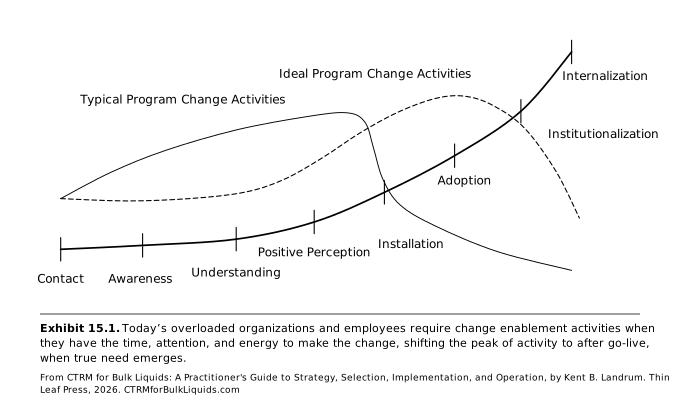
Exhibit 15.2Table
Chapter 16Renewable Fuels as a Trading and Compliance Domain
Exhibit 16.1Table
Exhibit 16.2Figure
The RIN lifecycle.
Until separation, the RIN travels with the physical gallon; after separation it is an independent commodity, sold in the market or retired against the obligation.
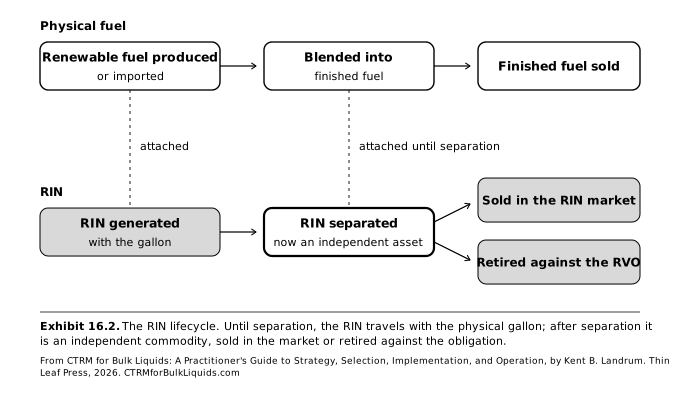
Exhibit 16.3Figure
The compliance application architecture.
The CTRM remains the commercial system of record and the ERP the financial one; the compliance application sits between them, owning obligation logic and registry integration.
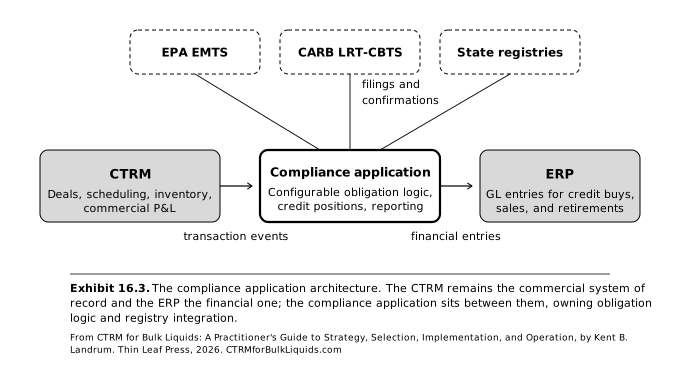
Exhibit 16.4Table
Chapter 17Fuel and Excise Tax Compliance
Exhibit 17.1Table
Exhibit 17.2Figure
Points of taxation along the fuel supply chain.
Federal tax attaches at the rack; states attach theirs at the rack, at the distributor's first sale, upon import into the state, or at retail sale, and a multi-state operator manages all of these structures simultaneously.
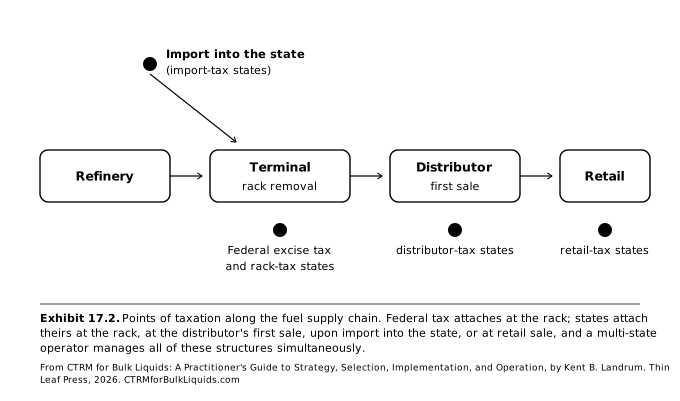
Exhibit 17.3Table
Chapter 18Risk Management and Analytics
Exhibit 18.1Figure
The risk reporting stack.
Every layer inherits the integrity of the layer below it; a risk metric built on a broken position layer is precisely wrong.
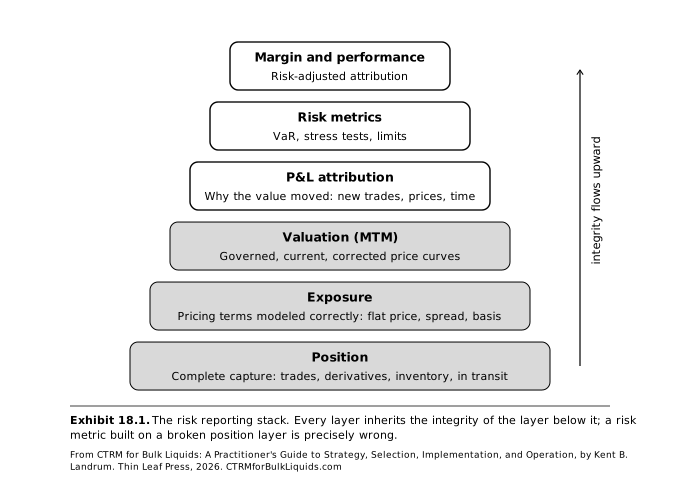
Exhibit 18.2Table
Exhibit 18.3Table
Exhibit 18.4Table
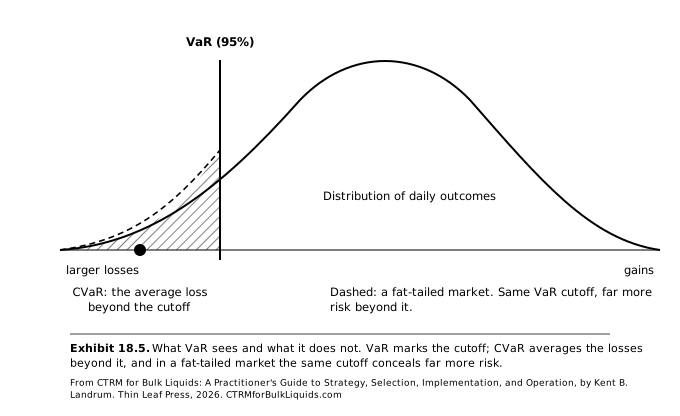
Exhibit 18.5Figure
What VaR sees and what it does not.
VaR marks the cutoff; CVaR averages the losses beyond it, and in a fat-tailed market the same cutoff conceals far more risk.
Chapter 19Leveraging Emerging Technologies
Exhibit 19.1Figure
The four AI maturity phases.
Most organizations operate in phases one and two; vendor attention concentrates on three and four, and no phase can be skipped.
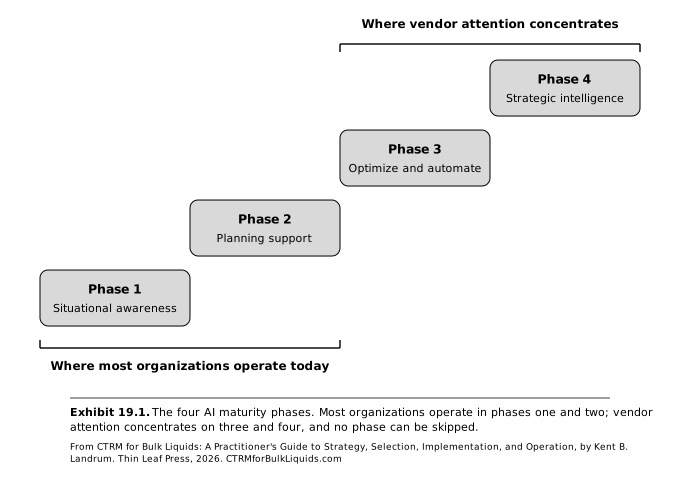
Exhibit 19.2Table
Exhibit 19.3Table
Data flows between CTRM and supply chain optimization infrastructure.
Further readingSupply Chain Optimization in Hydrocarbons with AI and Analytics (Article, JD Supra, 2025)
Exhibit 19.4Table
Chapter 20The Evolving CTRM Operating Model
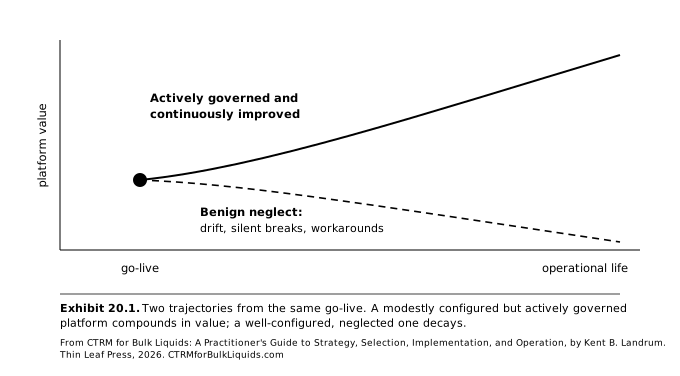
Exhibit 20.1Figure
Two trajectories from the same go-live.
A modestly configured but actively governed platform compounds in value; a well-configured, neglected one decays.